Research Interests
I have a wide range of research interests focused on understanding, protecting, and restoring the natural environment and the benefits humans get from healthy ecosystems. I am particularly interested in opportunities at the intersection of science and policy where science can inform policies and lead to solutions to environmental problems and more habitat conservation. These include the assessment and valuation of ecosystem services and I have worked with colleagues on incorporating ecosystem services into U.S. federal policies and programs (see for example, Fleming et al., 2018, Crooks et al., 2018, Polefka and Sutton-Grier 2016, Schaefer et al. 2015 and Sutton-Grier et al. 2014) as well as international policies (Howard et al. 2023, Howard and Sutton-Grier et al. 2017, Wylie et al., 2016).
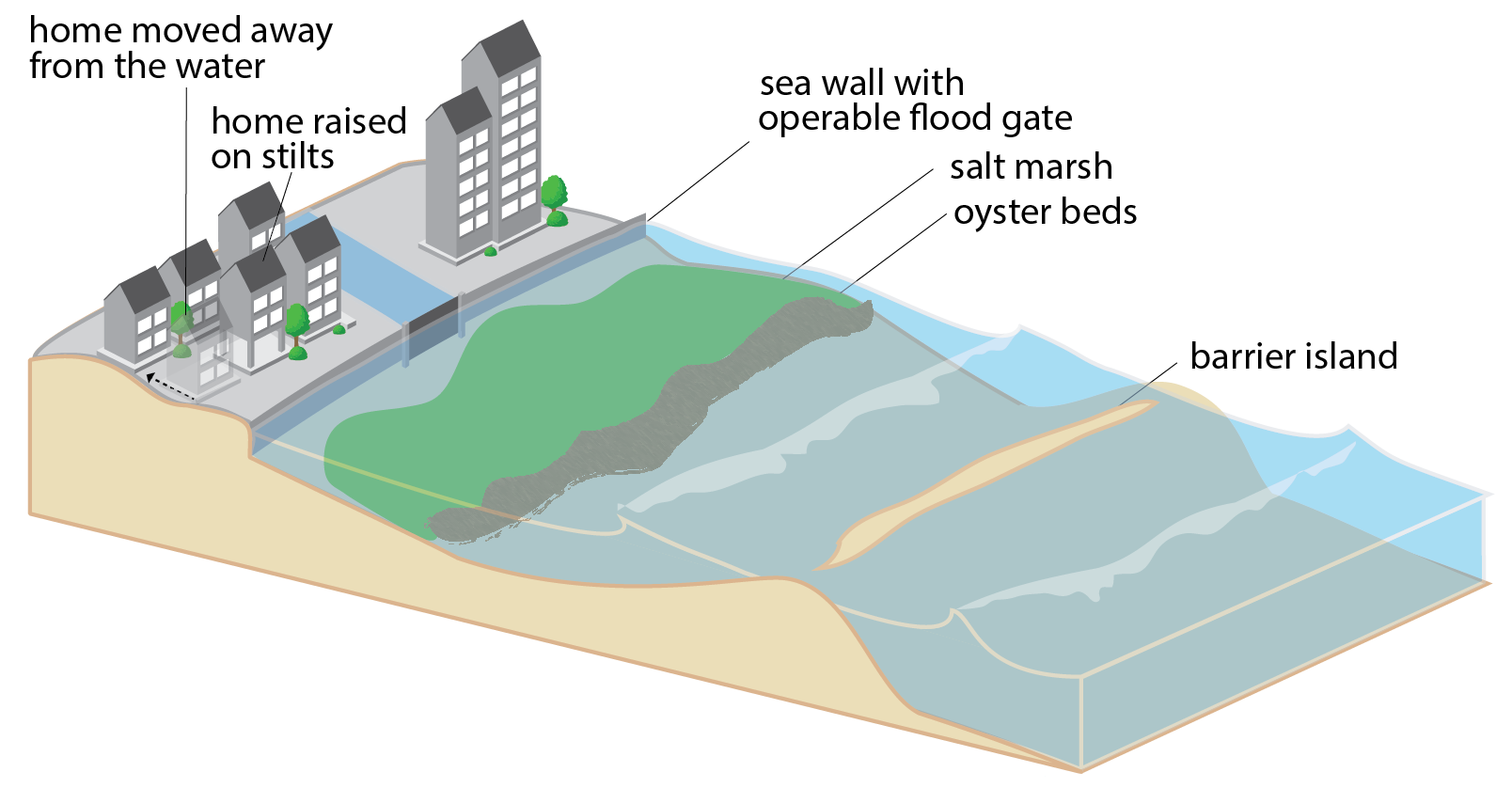 One effort I found particularly exciting was the opportunity to synthesize our understanding of the benefits provided by natural ecosystems, or hybrid infrastructure which combines natural and built features (as seen in the figure), to reduce the risks of coastal flooding and erosion from storms. The use of natural and hybrid approaches is of growing interest in the U.S. and globally and it is important to include these options in our coastal planning and decision making so that we have alternatives to simply building more and bigger sea walls along our coasts. The results of this research synthesis were published in the journal Environmental Science & Policy (Sutton-Grier et al. 2015), and this article won the 2016 Ecological Society of America "Innovation in Sustainability Science" Award. This research on natural and hybrid infrastructure to support coastal resilience is of broad interest, not just to coastal managers, but also has generated interest from the American Society of Civil Engineers, the Climate Change Business Journal, and the American Institute of Architecture. A more recent paper about natural infrastructure examines the opportunities to use natural and nature-based infrastructure to improve infrastructure investments in the U.S. (Sutton-Grier & Gittman et al. 2018).
A recent paper with colleagues examined four case studies of hybrid infrastructure approaches to improve coastal resilience (Palinkas et al. 2022). Two other recent papers with students analyzed the science needs to support coastal communities in their coastal resilience efforts and one finding was that communities desire more information on natural infrastructure options (Molino et al. 2020), and how to model how wetlands attenuate waves (Miesse et al. 2023). (figure credit: K. Crossett, NOAA)
One effort I found particularly exciting was the opportunity to synthesize our understanding of the benefits provided by natural ecosystems, or hybrid infrastructure which combines natural and built features (as seen in the figure), to reduce the risks of coastal flooding and erosion from storms. The use of natural and hybrid approaches is of growing interest in the U.S. and globally and it is important to include these options in our coastal planning and decision making so that we have alternatives to simply building more and bigger sea walls along our coasts. The results of this research synthesis were published in the journal Environmental Science & Policy (Sutton-Grier et al. 2015), and this article won the 2016 Ecological Society of America "Innovation in Sustainability Science" Award. This research on natural and hybrid infrastructure to support coastal resilience is of broad interest, not just to coastal managers, but also has generated interest from the American Society of Civil Engineers, the Climate Change Business Journal, and the American Institute of Architecture. A more recent paper about natural infrastructure examines the opportunities to use natural and nature-based infrastructure to improve infrastructure investments in the U.S. (Sutton-Grier & Gittman et al. 2018).
A recent paper with colleagues examined four case studies of hybrid infrastructure approaches to improve coastal resilience (Palinkas et al. 2022). Two other recent papers with students analyzed the science needs to support coastal communities in their coastal resilience efforts and one finding was that communities desire more information on natural infrastructure options (Molino et al. 2020), and how to model how wetlands attenuate waves (Miesse et al. 2023). (figure credit: K. Crossett, NOAA)
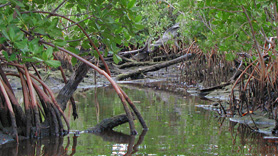 One of my primary efforts while I was at NOAA was to lead NOAA's Coastal Blue Carbon team. My expertise in wetland carbon cycling made me ideally suited to explore the science and policy opportunities for NOAA related to coastal blue carbon which have resulted in many publications including two high profile ones. We had a Nature Climate Change paper come out about the process of including coastal wetlands into the U.S. national greenhouse gas inventory (Crooks et al., 2018). And I helped include coastal wetlands into an analysis of US natural climate solutions that was published in Science Advances (Fargione et al., 2018). With several colleagues, I also published a paper on wetlands and climate change including the impacts of climate change on wetlands and how wetlands can help mitigate climate change (Moomaw et al. 2018) and the important role wetlands play in climate change adaptation (Endter-Wada et al. 2020). I also helped analyze whether and how carbon services of ecosystems can be incorporated into U.S. federal policies(Sutton-Grier et al., 2014and Pendleton and Sutton-Grier et al., 2013) and a recent update on progress on incorporating carbon benefits into U.S. efforts (Sutton-Grier and Moore, 2016). This work was also featured in the National Wetlands Newsletter. Working with a student, I also examined how blue carbon can be incorporated in international projects with the goal of conserving coastal ecosystems and supporting community livelihoods in developing countries (Wylie et al. 2016). The National Ocean Service also featured me in a podcast on Coastal Blue Carbon. And I awas a co-PI on a NASA carbon monitoring grant which is working to develop a framework for using remotely sensed data to estimate coastal wetland carbon stocks (Holmquist et al., 2018). I co-authored a couple of articles about why coastal wetlands are such good natural carbon sinks and should be part of our international climate change mitigation efforts (Howard et al. 2023, Howard & Sutton-Grier et al. 2017 and Sutton-Grier & Howard 2018). My work on coastal blue carbon was featured in a recent epidsode of the Ocean Currents Radio Show. (photo credit: NOAA Office of Habitat Conservation)
In my research scientist role at NOAA I also had the opportunity to work on several additional projects related to valuing ecosystem benefits to people. For example, I collaborated on an effor to incorporate storm protection benefits into the U.S. damage assessment process (Wellman et al. 2017). I also examined the relationship between nature and biodiversity exposure and human health and well-being (Sandifer and Sutton-Grier et al., 2015) You can view my ESA 2014 presentation on this study. And I recently publsished a paper on wetlands and human health (Sutton-Grier and Sandifer 2018). Another study synthesized our understanding of how stressors in the environment (such as nutrient pollution or ocean acidification) decrease coastal and marine ecosystem services thereby having negative impacts on human health and well-being (Sandifer and Sutton-Grier, 2014). A fourth study synthesized the negative impacts of derelict fishing traps on target and non-target species and on habitats (Arthur and Sutton-Grier et al., 2014). The first study I co-authored with NOAA authors examined the jobs created through restoration projects (Edwards et al., 2012). All of these studies aimed to help inform policy and decision making in coastal conservation.
In my doctoral and postdoctoral research, I examined how environmental factors drive ecosystem functioning, particularly nutrient cycling, and how these processes are altered due to human environmental change. Of particular interest are the roles that soil conditions and plant species play in driving nutrient transformations and greenhouse gas production.
My research focused on three themes: 1) Coupling of soil-microbial functioning, 2) Plant diversity and microbial links to biogeochemical cycling, and 3) Plant-soil-microbial feedbacks to the restoration of ecosystem function.
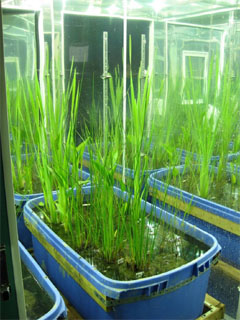 Species growing in the growth chamber at SERC. In my postdoc at the Smithsonian Environmental Research Center (SERC), I examined how different plant species and plant traits impact freshwater wetland microbial competition and methane production. I determined that as belowground biomass increases which leads to an increase in the oxygen transported to the microbes in the soil, methane production decreases (Sutton-Grier and Megonigal, 2011). I also examined the impact plant carbon inputs to soil have on microbial respiration and decomposition of soil organic matter via a reciprocal soil transplant experiment (Sutton-Grier et al., 2011a). At the Nature Precedings website you can view the presentations I gave of some of these results at the Ecological Society of America conference in 2009 (plant carbon data) and 2010 (plant trait and methane data).
In my dissertation, I examined how plant species and soil conditions influence nutrient transformations in restored wetlands. I focused on wetlands because they are unique ecosystems that connect the terrestrial and aquatic portions of the landscape, providing exciting opportunities for studying nutrient transformations in heterogeneous environments. I specifically focused on nitrogen (N) and carbon (C) dynamics and the connections between the cycling of these two elements. To address the challenges of studying the complex relationships between plants, soils, microbes, and nutrient cycling, I combined greenhouse studies of plant physiology with field studies of soil processes to address questions that intersect biogeochemistry, ecosystem ecology, and restoration.
I worked at two research sites for my dissertation research. I examined the importance of plant functional diversity on the nitrogen cycle in the Stream and Wetland Assessment and Management Park (SWAMP) in Duke Forest, Durham, North Carolina. In a second project I studied the role of soil organic matter amendments in the development of soil properties and microbial activity in a restored wetland in Charlotte, N.C.
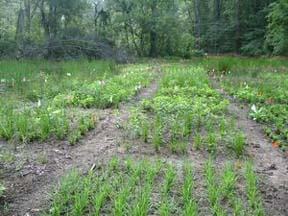 Duke Forest Biodiversity Site in July 2005. My biodiversity project combined a field study with a greenhouse study and my collaborator on this project was Justin Wright in the Duke Biology department. We measured plant traits in the greenhouse and then used those traits to calculate a measure of functional diversity to assess whether this measurement of diversity was more tightly linked to ecosystem functioning than the more traditional measure of diversity, species richness. See Funk et al. 2016, for a recent summary of how plant traits can help us understand ecological functioning.
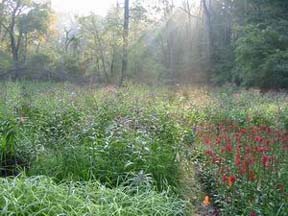 Duke Forest Biodiversity Site in September 2005. Our main findings from this experiment are that plant functional diversity significantly influenced denitrification potential through its interactions with soil conditions; increasing plant trait diversity led to increased denitrificaiton potential but mainly at higher soil resource levels (Sutton-Grier et al., 2011b). I presented these results at the Biodiversity and Restoration symposium at ESA, 2007. Working with colleagues we also determined that plant trait diversity buffers changes in denitrification potential through changing seasons and environmental conditions (McGill et al., 2010) and that a diversity of traits are important for maintaining multiple ecosystem functions (Sutton-Grier et al., 2012). I presented these last findings at the Ecological Society of America conference August, 2012 (view presentation).
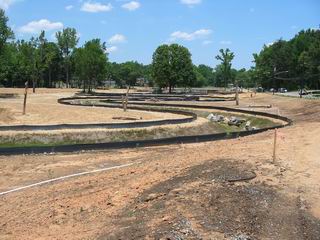 Charlotte site in June 2004. At this site I examined how soil compost additions have affected soil properties and and microbial activity over three years since restoration. Based on my results from this study, compost can be used to increase soil macronutrients, specifically nitrogen and phosphorus, which can benefit plant growth. Compost amendments can also stimulate microbial activity since I found higher rates of denitrification in plots with more compost (Sutton-Grier et al., 2009).
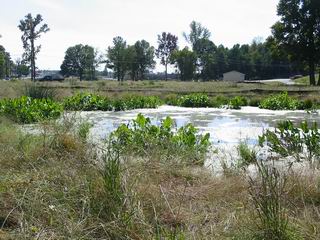 Charlotte site in September 2004. I also found that, even though the Charlotte and Duke Forest sites differ in many respects, both sites have similar soil ecosystem structure meaning that similar soil variables and relationships between soil variables can be used to predict denitrification potential at both sites. This suggests there are fundamental relationships between soil properties and microbial functioning that persist even when restored wetlands have very different histories and soil conditions. However, a similar soil ecosystem structure did not guarantee similar ecosystem functioning at both sites (Sutton-Grier et al., 2010).
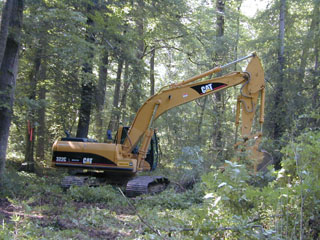 Duke Forest Restoration In Progress, 2005. I also had the opportunity to mentor a Master's student, Josh Unghire, on a research project examining the impacts of restoration activities on soil properties that influence microbial nutrient cycling. We determined that restoration activities decreased soil organic matter levels while increasing phosphorus levels, and homogenized their spatial distributions. Four years post-restoration, there were fewer organic matter "hot spots" which are important for biogeochemical cycling suggesting that microbial processing of nutrients in the restored site could be limited by the disturbance and homogenization that occurred during restoration activities (Unghire et al., 2011). (Photo credit: M. Ho)
To read more about my doctoral research, please see my dissertation online.
References
Howard, J., A. Sutton-Grier, L. Smart, S. Simpson, C. Lopes, J. Hamilton, J. Kleypass, J. McGowan, A. Pessarrodona, H. Alleway, and E. Landis. 2023. Blue carbon pathways for climate mitigation: Known, emerging and unlikely. Marine Policy.
Miesse, T.*, A. de Sousa de Lima, A. Khalild, F. Cassalho, D. Coleman, C. Ferreria, and A. Sutton-Grier. 2023. Numerical modeling of wave attenuation: implications of representing vegetation found in coastal saltmarshes in the Chesapeake Bay. Env Monitoring and Assessment.
Palinkas, C.M., P. Orton, M.A. Hummel, W. Nardin, A.E. Sutton-Grier, L. Harris, M. Gray, M. Li, D. Ball, K. Burkes-Copes, M. Davlasheridze, M. De Schipper, D. A Geroge, D. Halsing, C. Maglio, J. Marrone, S. K. McKay, H. Nutters, K. Orff, M. Taal, A. P.E. Van Oudenhoven, W. Veatch, and T. Williams. 2022. Innovations in Coastline Management With Natural and Nature-Based Features (NNBF): Lessons Learned From Three Case Studies. Frontiers in the Built Environment.
Molino, G.D.*, M.A. Kenney, and A.E. Sutton-Grier. 2020. Stakeholder-defined scientific needs for coastal resilience decisions in the Northeast U.S. Marine Policy. 118:103987. DOI: 10.1016/j.marpol.2020.103987.
Endter-Wada, J., K. Kettenring, and A. E. Sutton-Grier. 2020. Protecting wetlands for people: Strategic policy action can help wetlands mitigate risks and enhance resilience. Environmental Science & Policy.
Fleming, E., J. Payne, W. Sweet, M. Craghan, J. Haines, J.F. Hart, H. Stiller, and A. Sutton-Grier, 2018. Coastal Effects. In Impacts, Risks, and Adaptation in the United States: Fourth National Climate Assessment, Volume II [Reidmiller, D.R., C.W. Avery, D.R. Easterling, K.E. Kunkel, K.L.M. Lewis, T.K. Maycock, and B.C. Stewart (eds.)]. U.S. Global Change Research Program, Washington, DC, USA.
Crooks, S. A.E. Sutton-Grier, T. Troxler, N. Herold, B. Bernal, L. Schile-Beers, and T. Wirth. 2018. Coastal wetland management as a contribution to the U.S. national greenhouse gas inventory. Nature Climate Change.
Fargione, J.E., S. Bassett, T. Boucher, S.Bridgham, R.T. Conant, S.C. Cook-Patton, P. W. Ellis, A. Falcucci, J. Fourqurean, T. Gopalakrishna, H. Gu, B. Henderson, M. D. Hurteau, K. D. Kroeger, T. Kroeger, T. J. Lark, S. M. Leavitt, G. Lomax, R. I. McDonald, P. J. Megonigal, D. A. Miteva, C. Richardson, J. Sanderman, D. Shoch, S. A. Spawn, J. W. Veldman, C.A. Williams, P. Woodbury, C. Zganjar, M. Baranski, P. Elias, R. A. Houghton, E. Landis, E. McGlynn, W. H. Schlesinger, J. V. Siikamaki, A. E. Sutton-Grier, and B. W. Griscom. 2018. Natural Climate Solutions for the United States. Science Advances.
Holmquist, J., L. Windham-Myers, B. Bernal, K.B. Byrd, S. Crooks, M.E. Gonneea, N. Herold, S.H. Knox, K. Kroeger, J. McCombs, J.P. Megonigal, L. Meng, J.T. Morris, A.E. Sutton-Grier, T.G. Troxler, and D.Weller. (Accepted Manuscript). Uncertainty in United States coastal wetland greenhouse gas inventorying. Environmental Research Letters.
Sutton-Grier, A.E. and P. Sandifer. 2018. Conservation of Wetlands and Other Coastal Ecosystems: a Commentary on their Value to Protect Biodiversity, Reduce Disaster Impacts, and Promote Human Health and Well-Being. Wetlands. DOI.
Moomaw, W.R., G. L. Chmura, G.T. Davies, C. M. Finlayson, B. A. Middleton, S.M. Natali, J. E. Perry, N. Roulet, and A.E. Sutton-Grier. 2018. Wetlands in a Changing Climate: Science, Policy, and Management. Wetlands. DOI.
Wellman, E., A. Sutton-Grier, M. Imholt, and A. Domanski. 2017. Catching a wave? A Case Study on Incorporating Storm Protection Benefits into Habitat Equivalency Analysis. Marine Policy 83:118-125. DOI.
Polefka, S. and A.E. Sutton-Grier. 2016. Making ecosystem services part of
business as usual in federal governance. Frontiers in Ecology and Environment. 14(4):175. DOI.
Sutton-Grier, A.E. and A. Moore. 2016. Leveraging Carbon Services of Coastal Ecosystems for Habitat Protection and Restoration. Coastal Management.44(3):259-277. DOI.
*Wylie, L., A.E. Sutton-Grier, and A. Moore. 2016. Keys to successful blue carbon projects: Lessons learned from global case studies. Marine Policy. 65:76-84. DOI.
Funk, J.L, Larson, J.E., Ames, G.M., Butterfield, B.J., Cavender-Bares, J., Firn, J., Laughlin, D.C., Sutton-Grier, A.E., Williams, L. and J. Wright. Revisiting the Holy Grail: using plant functional traits to understand ecological processes. Biological Reviews. DOI.
Schaefer, M., E. Goldman, A. Bartuska, A.E. Sutton-Grier, and J. Lubchenco. 2015. Nature as capital: Advancing and incorporating ecosystem services in United States federal policies and programs. Proceedings of the National Academcy of Sciences. 112 (24):7383-7389. (also see the full issue on Nature as Capital)
Sutton-Grier, A.E., K. Wowk, and H. Bamford. 2015. Future of our Coasts: The potential for natural and hybrid infrastructure to enhance the resilience of our coastal communities, economies, and ecosystems. Environmental Science & Policy.51:137-148.
Sandifer, P.A., A.E. Sutton-Grier, and B.P. Ward. 2015. Exploring connections among nature, biodiversity, ecosystem services, and human health and well-being: Opportunities to enhance health and biodiversity conservation. Ecosystem Services. 12:1-15.
Sandifer, P. and A.E. Sutton-Grier. 2014. Connecting Stressors, Ocean Ecosystem Services, and Human Health. Natural Resources Forum. 38:157-167. DOI
Arthur, C., A.E. Sutton-Grier, P. Murphy, and H,. Bamford. 2014. Out of sight but not out of mind: Harmful effects of derelict traps in selected U.S. coastal waters. Marine Pollution Bulletin.
Sutton-Grier, A.E., A.K. Moore, P.C. Wiley, and P.E.T. Edwards. 2014. Incorporating ecosystem services into the implementation of existing U.S. natural resource management regulations: The case for carbon sequestration and storage. Marine Policy. DOI
Pendleton, L.H., A.E. Sutton-Grier, D.R. Gordon, B.C. Murray, B.E. Victor, R.B. Griffis, J.A.V. Lechuga, and C. Giri. 2013. Considering “Coastal Carbon” in Existing U.S. Federal Statutes and Policies. Coastal Management. 41:439-456. DOI
Edwards, P., A.E. Sutton-Grier, and G. Coyle*. 2012. Investing in Nature: Restoring Coastal Habitat Blue Infrastructure and Green Job Creation. Marine Policy. 38:65-71. DOI
Sutton-Grier, A.E., J. Wright, and C. Richardson. 2012. Different plant traits affect two pathways of riparian nitrogen removal in a restored freshwater wetland. Plant and Soil. 365:41-57. DOI
Sutton-Grier, A.E. and J.P. Megonigal. 2011. Plant species traits regulate methane production in freshwater wetland soils. Soil Biology and Biochemistry 43:412-420. DOI
Sutton-Grier, A.E., J. Keller, R. Koch*, C. Gilmour, and J.P. Megonigal. 2011a. Electron donors and acceptors influence anaerobic soil organic matter mineralization in tidal marshes. Soil Biology and Biochemistry. 43: 1576-1583. DOI
Sutton-Grier, A.E., J. Wright, B. McGill*, and C. Richardson. 2011b. Environmental conditions influence the plant functional diversity effect on denitrification potential. PLoS ONE 6(2): e16584. DOI
Unghire, J.M.*, A.E. Sutton-Grier, N. Flanagan, and C. Richardson. 2011. Spatial Impacts of Stream and Wetland Restoration on Riparian Soil Properties in the North Carolina Piedmont. Restoration Ecology 19(6):738-746. DOI
McGill, B.M.*, A.E. Sutton-Grier, and J. P. Wright. 2010. Plant trait diversity buffers variability in denitrification potential over changes in season and soil conditions. PLoS One 5(7): e11618. DOI
Sutton-Grier, A.E., M. Kenney, and C.J. Richardson. 2010. Examining the relationship between ecosystem structure and function using structural equation modeling: A case study examining denitrification potential in restored wetlands. Ecological Modelling. 221:761-768. DOI
Sutton-Grier, A.E., M. Ho, and C.J. Richardson. 2009. Organic amendments improve soil conditions and denitrification in a restored riparian wetland. Wetlands. 29:343-352. DOI
back to top
